Today, search is not restricted to ten blue links. Google AI Overviews, AI Mode, ChatGPT search, Perplexity, and other answer engines may extract information from a handful of relevant pages, combine it into an answer, and cite just a few of them.
This creates an important decision point for content creators: Should they refresh an existing page or publish a new page to address a new opportunity?
In most cases, content refreshing will deliver better AEO results if the existing page is still relevant to the user intent and has some sort of search equity. New content will work better if a new query requires a distinct answer, audience, format, or phase of the customer journey.
This decision is not the matter of old vs. new content. This is a decision between leveraging existing authority and creating clear semantic coverage.
Should You Refresh or Publish New Content for Better AEO Results?
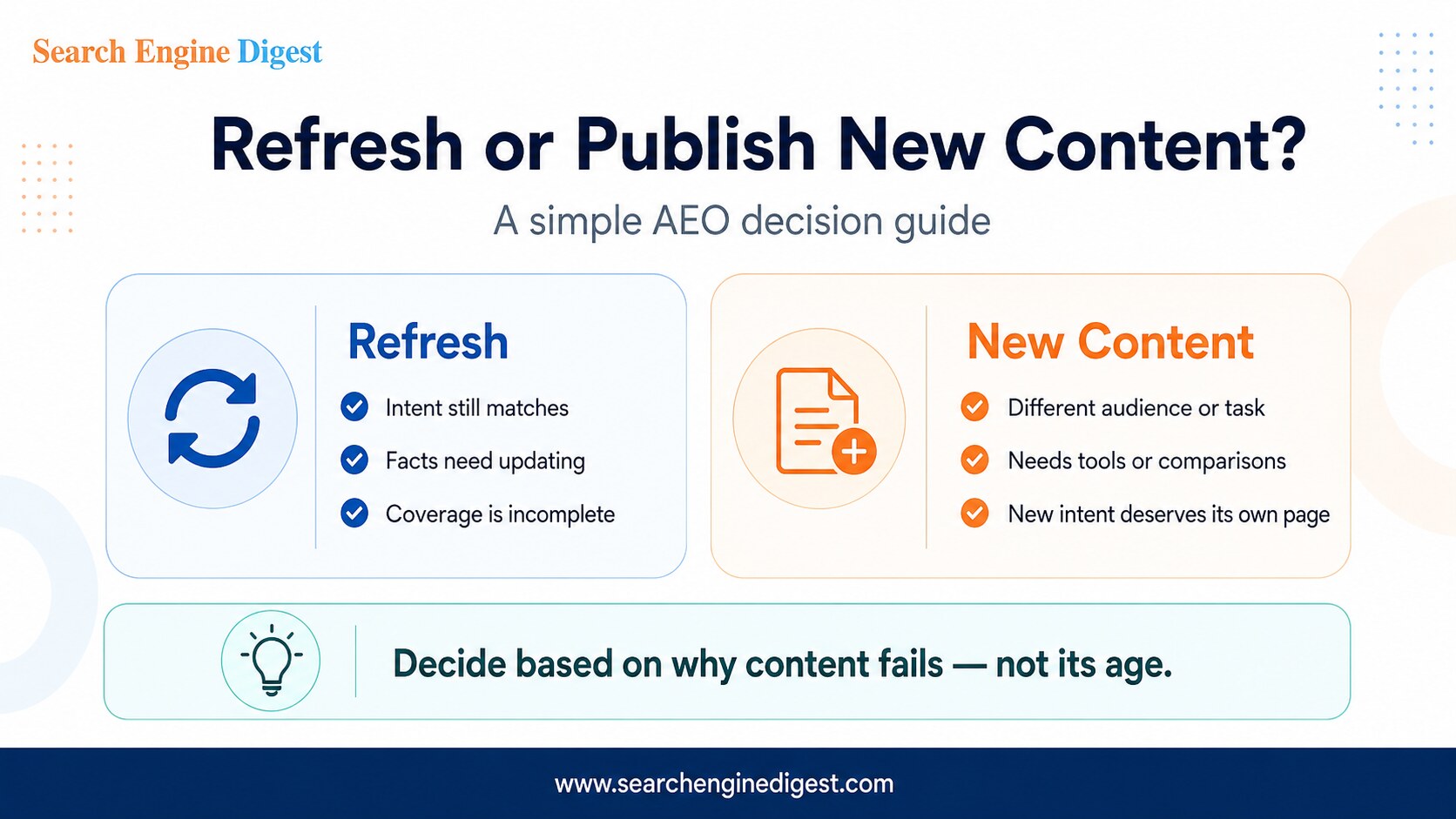
Use content refresh if the existing URL is ranked, linked, relevant, and supports conversions or already covers the topic but doesn’t provide the best answer anymore.
Publish a new piece if there is no way to satisfy the search intent without changing the main idea of the existing page.
|
Situation
|
Best decision
|
| Existing page matches the intent | Refresh |
| Outdated facts, examples, recommendations | Refresh |
| Existing page is ranked but lacks answer coverage | Refresh |
| Query serves a different audience or task | New content |
| Query requires tools, templates, or comparisons | New content |
| Several pages compete for the same intent | Refresh and consolidate |
The correct decision depends on why content fails, not on when it was created.
What Are AEO Results About?
Some marketers evaluate the success of AEO by the fact that their brand appears in the generated answer. Such an evaluation is far from perfect.
There are several stages on the way to generating useful answers. A page should be found, indexed, and considered relevant to a question or one of its subqueries. Only then it can become part of the answer.
But even appearance in the sources list is not the end goal. A page can appear in the sources list but have nothing of its arguments, data, or recommendations used in the generated answer.
For practical analysis, AEO results may be divided into the following levels:
- Retrieval visibility: The page is indexed for the relevant questions.
- Citation visibility: The URL appears in the sources list.
- Answer influence: The answer engine uses the page content or reasoning in its generated answer.
- Business impact: Visibility results in conversions or other business goals.
Content refresh works best when the page is already relevant but loses its relevance or accuracy. Publishing new content is better when there is no existing page that can generate the retrieval visibility.
What Is Content Refresh?
Content refresh is a significant improvement of an existing page that maintains the main purpose but improves its accuracy, relevance, usefulness, and completeness of the answer.
It is neither just changing the date, nor rewriting the introduction, nor adding several hundred words of unrelated information.
A content refresh may update the outdated statistics, fix the wrong data, delete irrelevant content, add important questions, improve internal links, add evidence to the page, and structure it according to the updated decision-making process.
Google repeatedly advises website owners not to change just the date to make the page look fresh. The page looks fresh not because it is recent but because it has new and meaningful content.
The goal of content update is not to make the page larger. The goal is to improve its answer.
Why Content Refresh Can Generate Better AEO Results Quicker
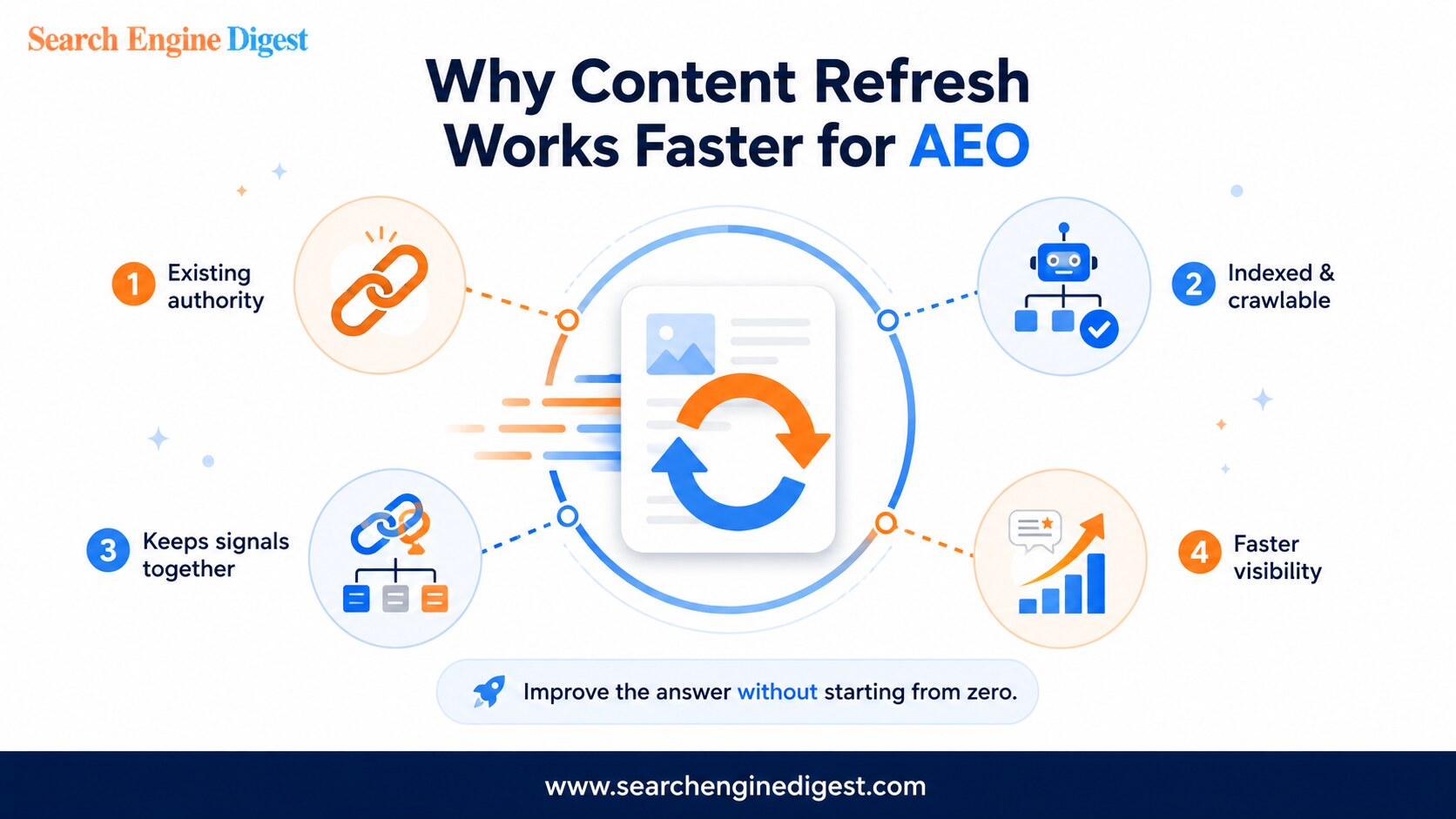
The existing URL already has backlinks, internal links, indexing history, rankings, and user engagement. The page refresh will allow the website to enhance its answer without the necessity of splitting the relevant signals between the URLs.
The reason for this is not that the AI model will remember the page forever. Most search-based answer engines use retrieval systems that select relevant, accessible content at the moment of the request. And a page that already exists and has authority for some of the relevant queries will have a natural advantage since it is indexed, crawlable, internally linked, and related to the topic.
A good content refresh can help the AEO visibility in four ways.
It Concentrates the Existing Authority
Publishing new pages for the same intent may dilute backlinks, internal links, and other relevancy signals.
A page refresh allows keeping the most comprehensive answer at one URL. Sometimes, it is better to consolidate several poorly-performing pages than refreshing them or publishing a new one.
It Repairs the Intention Drift
Search intent may change even if the keyword remains the same.
If “best project management software” required just a list of tools at the beginning, today, users want AI features, price limitations, integration possibilities, and recommendations regarding the size of the company.
The topic has not changed but the criteria to evaluate the answer have. And this is a good opportunity for a refresh.
It Improves the Quality of the Evidence
Answer engines need passages that can support claims. Generic statements do not provide any evidence.
Here are two examples of the evidence quality:
“Our workflow increases efficiency.”
“The workflow reduced the average approval time from five business days to two in 46 campaigns.”
The second example is more valuable because it defines the outcome, scale, and metrics of the improvement. Attributable and specific information is easier to trust and to parse for a retrieval system.
It Creates Better Answer Units
It becomes easier for a page to be understood when every part answers a question. Definitions, comparisons, decision rules, limitations, examples, and processes should be written in the form of complete answers rather than keyword-filled phrases.
Formatting may help with this but tables and FAQs do not create AEO value on their own. The information still should be relevant, original, and accurate.
When Is Publishing New Content Better for AEO Results?
A new piece of content is better in case when the information deserves an independent answer.
Take three pages: “What Is CRM Software?”, “CRM Implementation Checklist”, and “HubSpot vs. Salesforce”.
Three pages cover the same topic – CRM software – but they serve different purposes. The first page educates a novice, the second helps to implement, and the third makes the purchasing decision easier.
Trying to squeeze all three intents into one article will result in the creation of a broad page with no clear purpose.
Use new content in case when a query addresses a different audience, requires a different format, belongs to a different stage of the funnel, requires independent evidence, or supports its own conversion path.
But do not just publish new pages for every keyword variation. The AI-based search engine may expand the original query into several subqueries but that does not mean that you need to publish pages for all of them. A page should have its own purpose rather than just appear in the keyword tool.
The Content Leverage Audit
Rate each signal from 0 to 3.
|
Signal
|
Low rate
|
High rate
|
| Intent continuity | The proposed topic is different from the original one | The original intent did not change |
| Existing authority | The page does not have any visibility | The page has rankings, links, or conversions |
| Repairability | The page needs complete repurposing | Focused improvements can save the page |
| Answer independence | The new topic greatly overlaps the existing one | The new topic serves an independent user need |
| Information change | The opportunity is not relevant | There is important information change |
Sum up the first three signals to calculate the Refresh Leverage Score. A score of 7-9 strongly supports the refresh. A score of 4-6 suggests consolidation or repurposing. And a score of 3 or less means that the page may not require any effort.
Sum up answer independence and information change to calculate a New Content Need Score. A score of 5-6 suggests publishing a new page. Otherwise, the information probably can be included in the existing one.
The framework prevents teams from refreshing pages only because the traffic has decreased or publishing new pages just because a keyword has appeared in the research tool.
A Practical Content Refresh or New Content Example
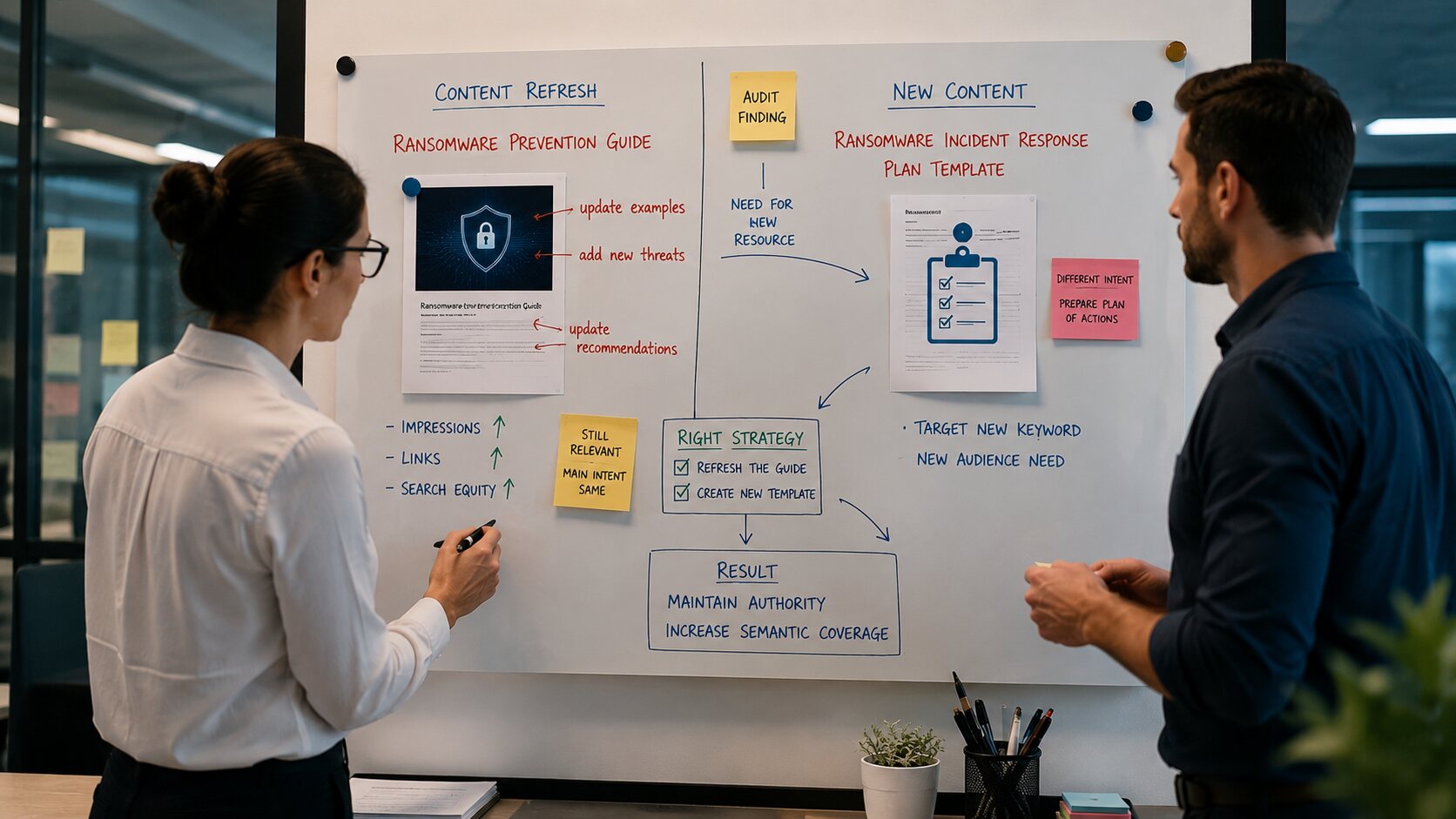
Let’s assume that there is a cybersecurity company with an established “Ransomware Prevention Guide”.
The page still gets impressions and links but the examples become outdated, the page ignores some of the modern ransomware threats, and recommendations do not correspond to the current security practices.
The main intent of the page – help organizations to protect themselves from ransomware – has not changed. So, the page needs a refresh.
During the audit, the company realizes that there is also the need for “Ransomware Incident Response Plan Template”. The topic is similar but the intent is different. Users want to learn how to prevent ransomware. Now, users need to prepare the plan of actions.
The right strategy here is to refresh the guide and to create a new page for the template.
This strategy maintains the existing authority and increases semantic coverage.
How to Refresh the Page for Better AEO Results
Start with finding the failure stage of the page. Do not rewrite the introduction immediately.
If the page has no impressions, it may be an indexing problem, internal linking issues, or incorrect intent.
If the page has impressions but loses rankings, it has outdated coverage.
And finally, if the page is ranked but does not drive any business, it has the wrong conversion path or audience.
After this, redefine the questions set. Find the main question and all the subquestions users need to resolve before the action.
Include the subtopics but avoid turning the page into the keyword collection.
Then, conduct the evidence audit. Analyze every important claim to understand whether it is current, supported, outdated, vague, derived from personal experience or just repeated from another source.
And finally, add unique information to the page. This may be the internal data, experts’ observations, decision rules, processes, screenshots, negative examples, limitations, or methodology.
Before publishing the content, check whether the page is indexed, uses the right canonical URL, has relevant internal links, loads its important information properly, and is accessible for the search engines.
How Content Freshness Impacts the AI Citations
Content freshness is not just a fact of recent changes. It is about the relevance of the information for the question being asked.
Freshness is especially critical for laws and regulations, prices, software features, product specifications, medical advice, statistics, standards, and recommendations.
It is less important for stable topics like historical explanation or definition.
In the case of AEO, the best signal of freshness is consistency. The date of the publication, facts, sources, screenshots, examples, and recommendations should refer to the same period. An updated date with outdated information will just decrease trust to the page.
Mistakes of AEO Content Strategy

Refreshing all the declining pages is a waste of time and resources. Some pages lose traffic because the demand has disappeared, the existing page is better for the intent, or the topic is not aligned with the business goals anymore.
Also, mistakes occur in cases when teams just create pages for every long-tail query. It decreases the authority of the existing pages and provides very shallow coverage.
Another mistake is using only the formatting. Short paragraphs, tables, and FAQ sections improve readability but cannot help with unsupported or generic content.
The main question still remains: Is this page answering the user question?
How to Evaluate the Success of the Content Strategy
Content refresh and new content should be measured differently.
In case of a refresh, you should analyze the performance of the page before and after the update. Measure whether the page has gained new queries, expanded into relevant subtopics, improved engagement or conversion. And finally, check whether the page now appears in questions that were answered only by competitors.
In case of new content, start with measuring its discovery and query coverage. Make sure the page is indexed, internal links clarify its position, and it attracts the relevant audience, not overlaps with the existing one.
Measuring rankings, citation appearances, assisted conversions, branded searches, engagement, and the quality of the queries covered by the page will help to assess the success of the strategy.
A successful AEO content strategy improves both visibility and usefulness of the answer. The strongest result is not citation – it is becoming an influential source of valuable information.
Final Thoughts
The answer to the question of content refresh or new content is not just refresh everything or publish more.
Content refresh provides a leverage that allows improving an already established answer. Publishing new content allows covering new user needs.
The best AEO content strategy is to combine these two approaches selectively: refresh pages with the recoverable authority, cover new information gaps with the new pieces, consolidate duplicate content, and remove unnecessary pages.
Frequently Asked Questions